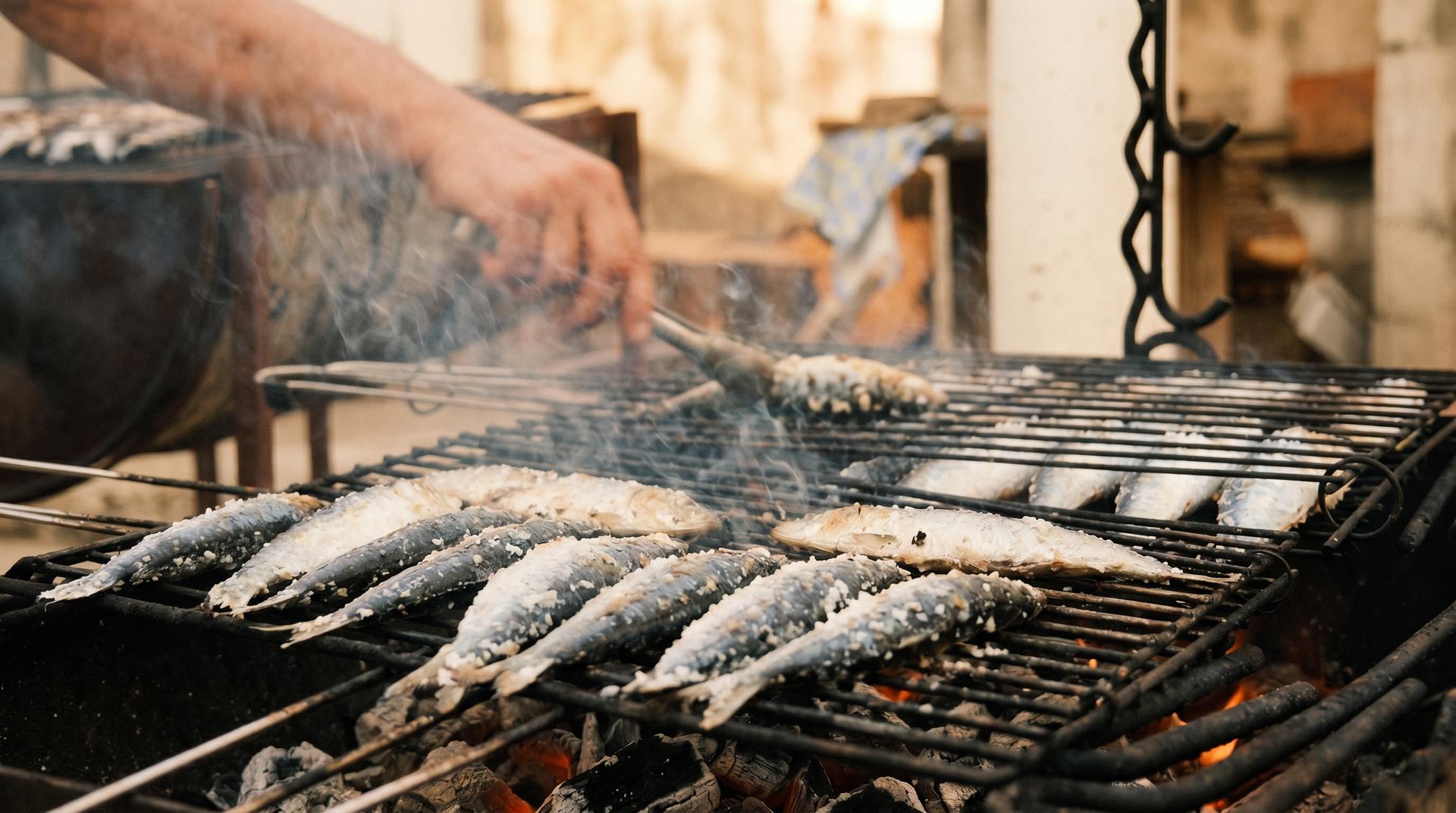
We walked to the village hall on the evening of the sardines festival. It was a short walk, the kind you make in a village like ours, where the houses are close together and the lanes are narrow and you do not need a car for anything that matters. The smell was the thing I noticed first, even from our door. Sardines on charcoal, carried on the heat of an afternoon that had not yet begun to cool, drifting through the stone walls and the lanes.
Santos Populares is the season of the Popular Saints in Portugal. Santo António on the thirteenth of June, São João on the twenty-fourth, São Pedro on the twenty-ninth. Every village holds some version of these festivals through the month, in the way they have been held for many hundreds of years, with bonfires and grilled sardines and rockets above the rooftops to announce that something is happening. In our small village in central Portugal, the sardines festival is one of them. The foguetes had been going off most of the afternoon, sharp as gunfire to anyone who has not lived with them before, and by the time we walked up to the hall they had quieted. The village was gathering.
We were the only outsiders. I realised this as we got closer, in the way you realise these things, without needing to look around very carefully. The festival had not been advertised. There was no sign at the bottom of the lane saying tonight's event. There was no version of it that had been organised for anyone who was not from here. It was simply a thing the village holds for itself each year, the way it has always held it, and we were on the lane because we live here now.
Outside the hall, on the cobbles, two of our neighbours stood at the charcoal grill working through the sardines. They saw us. They waved. They went back to the fish.
How a Portuguese Village Welcomes Children at a Festival
We brought the children inside. What happened next is something I am still trying to put words to. They were greeted by every single person who saw them. Not greeted in the formal sense, not greeted in the way an adult is greeted at the door of a party. Greeted the way you greet a small relative you have been waiting for all afternoon. Hugs. A kiss on the cheek. A hand reaching out to ruffle hair. A face leaning down to make a joke they could not yet understand, which they laughed at anyway because the joke was not the point. The point was the leaning down.
It was the neighbours we already see in the lanes, the ones whose names the children now know, who were most central. The older woman from a few doors away, who in any other country might have been called formal or restrained, was on her knees on the floor of the village hall within a minute of us arriving, playing some game I could not follow. The man who passes us most mornings on the way to his garden was teaching my daughter to clap to the music. The other children, ones we barely know by name, were quickly inside our two, leading them through the hall by the hand.
I do not think I can fully describe this to anyone who has not lived in a place where it happens. Children are not, here, an interruption. They are not, here, something to be managed quietly at the edges of an adult event. The festival was not happening despite the children. The children were part of the festival. The adults treated them, on entry, as a small piece of good news.
The Food at a Real Santos Populares
Inside the hall there were long tables down the middle, the kind a village owns because it has owned them since the people in the village were children. The food on them was not catered. It was brought. Each family had brought something from home, made that morning or the day before, set down without ceremony in the place on the table where there happened to be space.
The grilled sardines came in from outside in flat trays as they were ready, smoke still rising off them, set down whole onto bread the way they have been served at these festivals for the better part of two hundred years. Sardines became a festival food in the nineteenth century, when the large fish in Portugal went to wealthy tables and the small ones went to everyone else. The festival, the way it is held now, still carries something of that history in it. The sardine is the people's fish. It is cooked outside, on charcoal, eaten with the fingers and the bread.
Around the sardines were the other things. Salads of roasted red peppers in olive oil and garlic, the kind central Portugal does almost without thinking, called pimentos assados. Broa, the dense corn bread that is more central Portuguese than any other bread you will find on these tables. Bowls of green salad. Olives that someone had cured themselves. And at the end of the tables, on the wood, the desserts. Arroz doce, the rice pudding with cinnamon dusted on top in patterns the older women still know how to draw with their fingers, which sits at the centre of almost every Portuguese festival meal. Filhós, the fried sweet dough that arrives in baskets and gets eaten with the hands. Aletria, a sweet vermicelli pudding I had not heard of before that night, which one of our neighbours pressed on me with a confidence that did not really allow me to refuse.
And the wine. The wine is the part you cannot write about properly unless you have been at one of these tables. It came in clear glass bottles with no labels, no vintage year, no producer name. Each bottle was made by somebody in the room, or someone they were related to, from grapes grown on land they could probably see from their kitchen window. The wine is the thing that tells you most clearly what kind of culture you are in. It has not been industrialised here. It has not been separated from the land or from the people who made it. It is poured into your glass by the person who made it, and there is no way to taste it without understanding that fact.
What You Learn at a Portuguese Festival Without the Language
I want to be honest about the language. We do not yet speak the kind of Portuguese that lets us hold conversations of any complexity. We can manage at the market, we can manage at the bakery, we can manage on the school run. We cannot yet sit at a long table and hold our own in five overlapping conversations about land and weather and the people in the village who are not there tonight.
What I learned, at the festival, is that this matters less than I had thought. I had assumed, in the way you assume things from outside, that language would be the wall between us and being inside this kind of evening. The festival corrected that assumption.
There is a great deal you can communicate without language. The handing of a piece of bread is its own sentence. The pouring of wine into a glass you did not realise was empty is a sentence. The laugh at something a child has done is a sentence. The squeeze on the shoulder as somebody passes behind you is a sentence. By the end of the evening, I had exchanged more than I could have predicted with people whose Portuguese I caught perhaps one word in ten of. We had managed.
The festival was not arranged with us in mind. There was nothing in it that had been softened for outsiders. We were folded in because we were there.
What This Kind of Culture Is, From the Inside
I have been turning the whole evening over since. I think what I keep coming back to is the absence of any negotiation. We were not invited and we were not refused. We did not need to ask. We did not need to perform. The village was holding its festival, and we lived in it, and we went. The simplicity of that is what is hardest to describe to anyone who has not seen it.
In the country I came from, this kind of gathering would have been arranged. There would have been tickets, or a list, or an invitation, or at least a polite enquiry as to whether you were planning to come. There would have been some apparatus around it, some way of separating the people who were inside the event from the people who were not. Here, in the village, the apparatus does not exist. The village does not have a separate way of treating outsiders. It has one way of being, and you are either in it or you are not, and the only way to be in it is to show up and let the evening take you where it goes.
I think this is the thing about village culture in central Portugal that almost no English-language writer reaches, because it is something you cannot see from outside it. You have to be standing in the hall with a glass of unlabelled wine in your hand, with a child you have just met on the floor beside your child, with a woman you do not know offering you a piece of arroz doce you did not realise was yours, before you understand what the place is. It is the absence of the apparatus. It is the absence of the separation. It is the fact that culture here is not a thing you can attend. It is a thing you can only inhabit.
I think this is also why so much of what gets written about Portugal in English misses the point. Travel writing is structured around access, around the visitor being shown things they would not otherwise see. Village life in central Portugal does not work like that. There is nothing to be shown, because nothing is being staged. The thing the visitor is looking for cannot be performed for them. It can only be lived inside, slowly, over months, by being someone who happens to live on the lane.
Walking Home
We left when we left. There was no formal end, the way these things have no formal end, and we walked home alongside one of our neighbours, the children half asleep on our shoulders. The night had cooled. The wine on our breath was the wine she had brought to the hall. The cobbles were quiet again. The foguetes were finished for the night.
The next morning the village would go back to being what it normally is, which is to say a small collection of stone houses and narrow lanes and people who have known each other for generations. But the evening had shifted something for us. The children had been received by an entire village. We had been folded in, with no announcement, with no ceremony, in the only way the village knows how to fold people in, which is the way it has folded people in for the better part of a thousand years.
This, I think, is what people who write to me from cities, asking whether moving to a Portuguese village would actually be possible for them, are quietly wondering about. They want to know whether the warmth is real. Whether the integration is anything more than a brochure phrase. I do not know how to give them an answer in the abstract. I can only describe what happened on the evening of the sardines festival, the smoke from the sardines on the cobbles outside, the long tables, the wine without a label, the children greeted by every face that saw them, and the walk home with a neighbour, the village quiet again behind us. That is what it looks like. That is what was real.
The new video on the channel goes deeper into what village life in central Portugal actually looks like across six months. I would rather you watched it and let the images do the rest of the work than have me write any more here.
← Back to Journal Raising Young Children in Central Portugal: Four Months After Moving From Scotland →