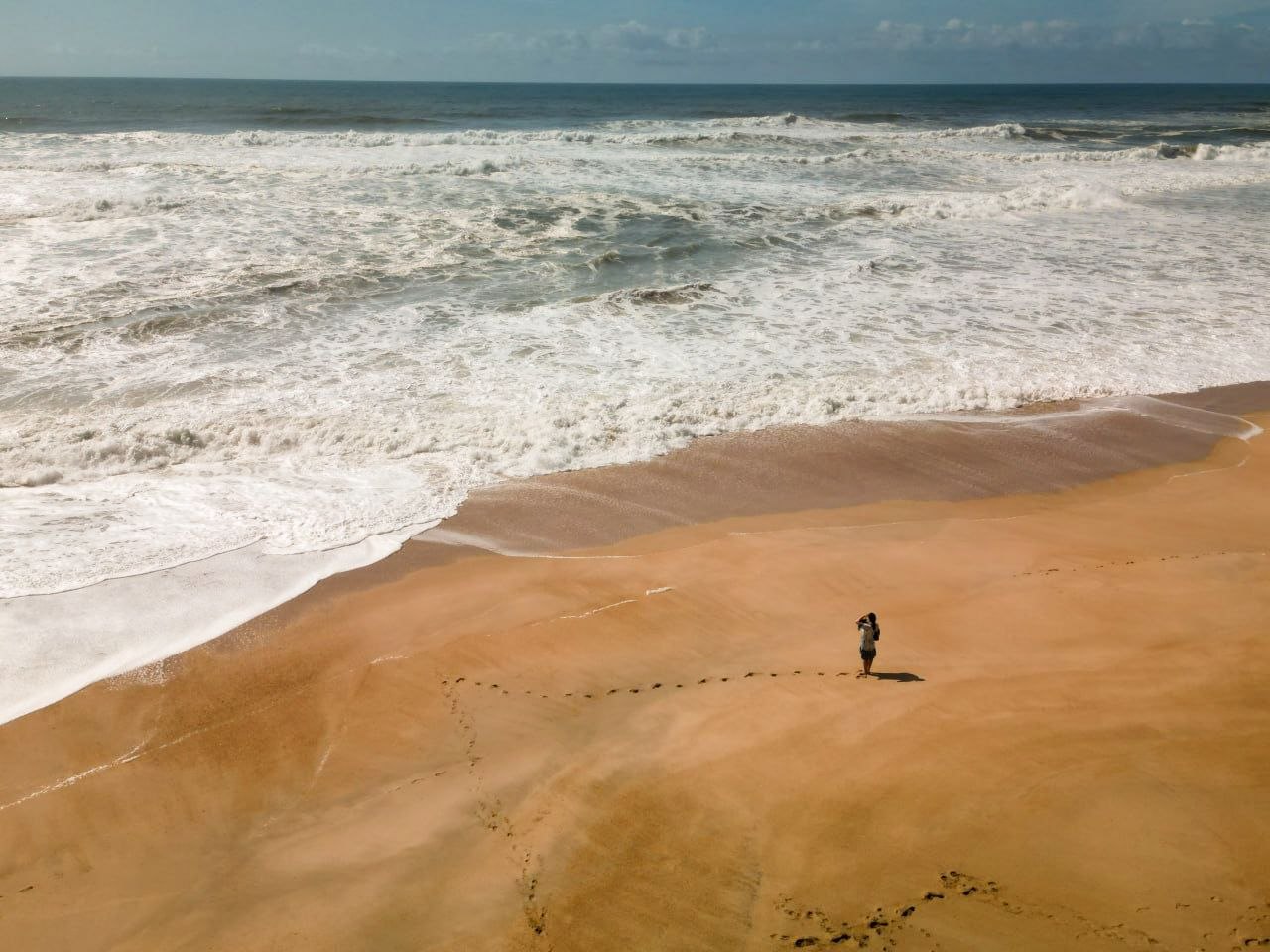
There are places you love while you are in them, and there are places that come home with you, and for a long time I did not know there was a difference.
Portugal was a blind country to us. We had never been. We knew almost nothing about it beyond where it sat on a map, at the western edge of Europe, past the point where most people stop looking. We had no picture of what a life inside it might be like, because we had never had any reason to build one.
My husband went first. He decided one day that the only way to know a place was to see it, and he booked a short trip on his own without much of a plan, and from the first day he was there he fell for it. By the time he came home he already knew that I would too. That is where all of this started, and I want to be plain about how little there was to it. Not a decision. Not a plan. One person coming back from a country and saying, quietly, that he thought this was it.
A few months later the three of us went together, with our first child, who was six months old.
I understood within a day.
What the honeymoon is, and why you cannot trust it
I want to be honest about that stay, because it would be easy to hand it to you as evidence and it is not evidence.
We were new. Everything was new. The ocean took something off us in the first week, the way it does. The food arrived all at once and the light arrived all at once and nobody around us appeared to be hurrying or carrying the particular tension we had come to accept as the ordinary condition of a week. All of that was real and I would not take a word of it back. But it was the country performing, and the country performs for everybody, and a place that has a functioning tourism industry is designed to make you feel exactly what I was feeling.
That is not information about whether you could live somewhere. It is information about whether you are on holiday.
The honeymoon is available to anyone, in any country, for the first few weeks of any stay. Nothing has worn off yet. No bureaucratic difficulty has begun, because you have not attempted anything that would require it. The neighbour is still a face rather than a person you have had a small disagreement with. The market is a discovery rather than the place you go on Tuesdays because it is Tuesday. It is beautiful and it is one of the reasons people fall in love with places, and it is not the country you would be living in.
It is beautiful, and it is not the country you would be living in.
The only test that told us anything
There is no shortcut past it. You cannot read your way past it and you cannot decide your way past it. What you can do is stay long enough, and use the place ordinarily enough, that the newness runs out, and then look at what is left standing.
Ordinarily is the word that matters. Not the restaurants and the walk along the front, but the things a person who lives somewhere actually does. Buy your food where the food is sold. Cook in a kitchen you are borrowing. Sit in a queue at an office for something small. Take a car to a garage. Send a package. Speak to somebody over a fence. Go to a café at eight in the morning and look at who is in it and what they are doing.
We did that without meaning to, during a stay in the Algarve in 2022 that lasted five months and was supposed to be the beginning of something longer. We used the post office. We opened accounts. We stood in queues. We spoke to the man who came to fix the water heater, and to the fishermen at the harbour, and to the woman in the small supermarket at the top of the hill. Almost none of it was pleasant in the way a holiday is pleasant. Most of it was slightly confusing.
All of it was information, and the information was this. We felt more at home inside the confusion here than we had felt inside the smooth functioning of everything back in Scotland.
I would add one thing, which is more important than it sounds. Go in more than one season if you possibly can, and if you can only go once, go in the worst one. The country that enchants you in May is a different country in November, and what you feel in the grey damp weeks is much closer to the truth than what you feel in July.
We felt more at home inside the confusion here than we had felt inside the smooth functioning of everything back in Scotland.
What comes home with you
Here is the part I would most want to give somebody standing where we were standing, because it costs nothing and it is the only reliable thing I know.
The feeling is not what you experience while you are in the country. Anybody can have that. The feeling is what you carry when you leave.
We came home. The trip ended and ordinary life resumed and the years began to gather in the way years do, and it did not fade. It came back to Scotland with us and it stayed. It was there in the small hours. It came up in the middle of an ordinary Wednesday for no reason at all. It did not soften when I tried to be sensible about it, and it did not go away when it became inconvenient, and it was still there in the morning.
If that happens to you, something real is going on.
And if it fades within a fortnight of being home, and only comes back when you look at your phone in the evening, that is different information and it is not worse information. Some of the places we love are not the places we are meant to live in. The distinction is a genuine one, and there is no way to discover which one you are holding except by leaving and paying attention to what remains.
What the country will not do for you
One last thing, because I carried a version of it for years and I think most people at this stage do.
It is the idea that the country is the answer. That if you can only get here, the life will happen, and the light and the food and the sea and the slower pace will do the work of settling you that your current life has not done.
I would say gently, from the other side, that this is not quite true. The country is not the answer. It is the ground the answer becomes possible on. What actually settles a person is the ordinary life they build once they are inside it, which is not the light and is not the sea. It is the walk to the same bakery. It is the neighbour whose name you eventually learn. It is the third grey morning of the week when the stove takes three attempts to light and you make the coffee anyway.
That is a smaller gift than the one people imagine they are being offered. I have come to think it is a better one.