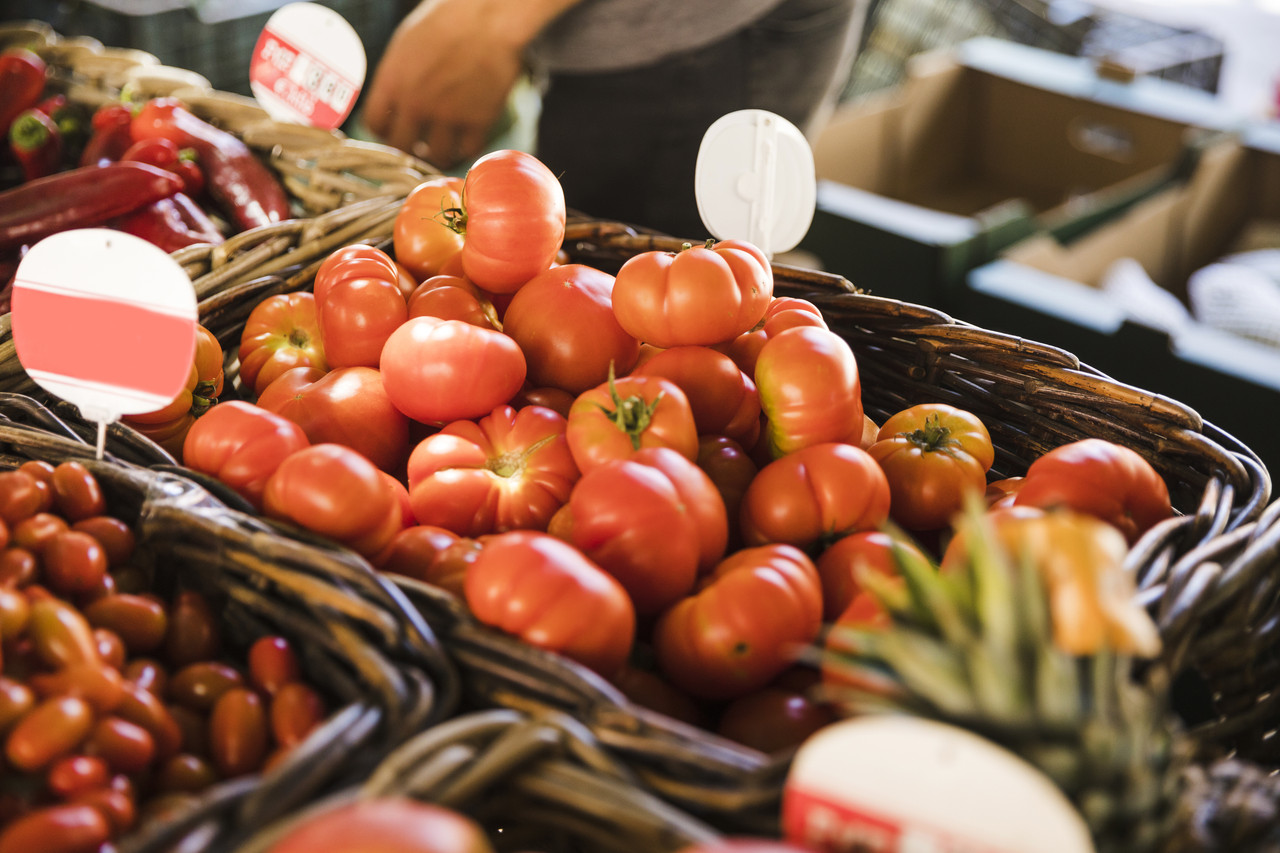
I want to describe the difference between buying vegetables at our village market and buying them at a supermarket, because it is not a difference I can easily summarise. It touches on food quality, human connection, time, and the nature of economic exchange in ways that feel important to say plainly.
What happens at the supermarket
At a supermarket, you take a trolley from a stack and move through corridors of identical products arranged according to someone else's logic, lit by overhead fluorescents, accompanied by music selected to slow your pace and increase your dwell time. You make choices between options that look similar and are priced similarly. You pass the produce section, which contains vegetables that were picked days or weeks ago, selected for visual uniformity and resistance to transit damage, and held at precise temperatures to slow their deterioration. You put some of these vegetables in a bag, weigh them at a machine, print a label. You take them to a checkout. You pay. You leave.
The transaction is frictionless. It is designed to be. No one needs to speak to you. No knowledge of the food is required. You do not need to know anything about what you are buying, where it was grown, who grew it, what variety it is, when it was picked, what it tastes like. The system does not require or invite that knowledge.
What happens at the market
At the village market on Tuesday morning, Dona Filomena is there with her table of tomatoes, and Dona Filomena's tomatoes are different every week because they are what she grew. Some weeks there are three varieties. Some weeks there is one. Sometimes a heavy rain has split the large ones and she sells them cheaper, the split ones first, and tells you to eat those today. She knows what is good and she tells you, because she grew it and she wants you to come back next week and she takes some pride in what she has produced.
You do not have to talk to Dona Filomena. But the option exists, and the option changes the transaction. There is a human being on the other side of it who has a stake in the quality of what you are buying. This turns out to matter, in ways that go beyond mere information.
There is a human being on the other side of it who has a stake in the quality of what you are buying.
The food itself
The practical differences are significant. Market vegetables here are almost always harvested within the last twenty-four to forty-eight hours. Supermarket vegetables, in the best case, were harvested within the last week. In the worst case, and this is common with produce that has travelled from large growing regions, two to three weeks. Nutritional degradation begins at harvest. The gap in vitamin content, in flavour compounds, in the quality of the food is real and measurable.
I am also buying varieties that do not exist in supermarkets, because supermarket varieties are selected for everything except flavour. The tomato that travels well and stores well and looks perfect after ten days of cold storage tastes of almost nothing. The tomato that is grown for taste and eaten within two days is one of the most extraordinary foods I know.
What it changes in the kitchen
I cook differently now. Not because I have learned new techniques, though I have, but because the relationship between the cook and the ingredient has changed. When you know the food, when you have spoken to the person who grew it, when it smells right and feels right and you know exactly when it was picked, you want to do less to it. Elaborate preparations start to seem like interference. The best cooking I do now is the simplest: good olive oil, salt, time, heat, and ingredients that were worth buying.
The supermarket model of food, uniform, abundant, available at all times regardless of season, frictionlessly purchased, has produced a generation of people who do not know what food actually tastes like. I include myself in that generation. I did not know what a tomato tasted like until I was in my thirties. That is worth sitting with.